Medical records are the backbone of personal injury, medical malpractice, and mass tort litigation. But mishandling protected health information (PHI) can expose law firms to compliance risks, evidentiary challenges, and reputational damage. A HIPAA-compliant medical records review process protects client privacy while delivering litigation-ready medical insights without slowing down case strategy.
This article is for attorneys and law firms handling or summarizes medical records, HIPAA compliance directly impacts your legal risk and case outcomes.
What Is a HIPAA-Compliant Medical Records Review?
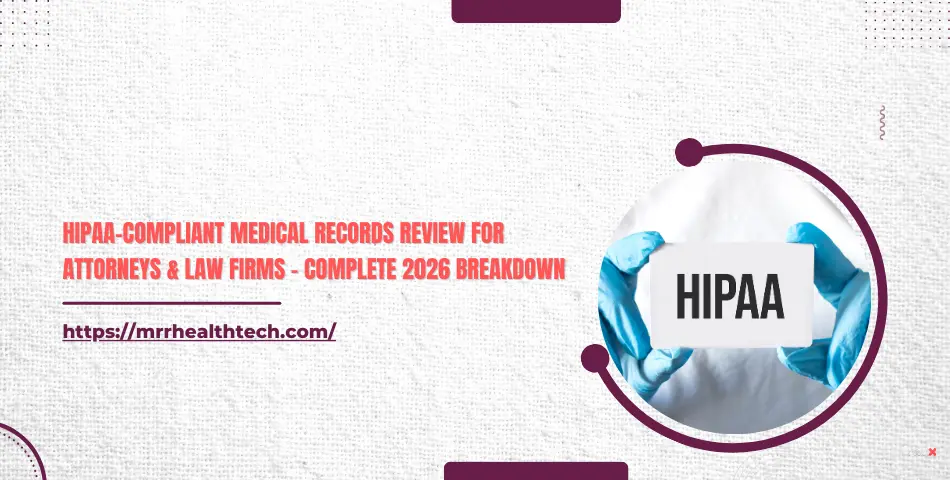
A HIPAA-compliant medical records review is a structured, documented process for handling PHI in line with HIPAA Privacy, Security, and Breach Notification Rules during legal case preparation.
It ensures that:
- Access to PHI is lawful (authorization, subpoena, court order)
- Only the minimum necessary information is reviewed and disclosed
- Data is protected during intake, storage, review, and delivery
- Every access point is auditable
- Outputs (chronologies, narratives, billing summaries) do not over-expose PHI
For attorneys, this means medical evidence can be used confidently without introducing compliance vulnerabilities.
Why HIPAA Compliance Matters in Litigation?
- Medical Records obtained improperly can be challenged
- Over-disclosure in exhibits can trigger compliance concerns
- Insecure handling can expose PHI in discovery
- Vendor mishandling can create downstream liability
What HIPAA-compliant review solves?
- Preserves admissibility of medical evidence
- Reduces risk of data exposure
- Protects client trust
- Supports defensible litigation workflows
In 2026, courts and clients expect law firms to demonstrate mature data handling practices not just legal competence.
What HIPAA Actually Requires When Attorneys Handle Medical Records?
HIPAA does not prevent attorneys from using medical records but it requires lawful access and secure handling.
Key requirements attorneys must meet:
- Obtain valid HIPAA authorizations or legally sufficient subpoenas
- Apply the minimum necessary standard
- Limit PHI access to trained personnel
- Use secure transmission and storage
- Maintain policies, training, and audit logs
- Follow breach response procedures if PHI is exposed
These requirements apply whether review is done in-house or outsourced.
How HIPAA-Compliant Medical Records Review Works in Practice?
A defensible, compliance-first workflow:
- Lawful Intake: Verify HIPAA authorization, subpoena, or court order before accessing records.
- Secure Storage: Records are stored in encrypted systems with role-based access control.
- Trained Review Team: Only HIPAA-trained analysts (clinical + legal) handle PHI under NDA.
- Minimum Necessary Review: Only records relevant to causation, damages, and timelines are analyzed.
- Controlled Outputs: Chronologies and summaries are designed for litigation use without unnecessary PHI exposure.
- Secure Delivery: Encrypted portals or secure file transfer never open email attachments.
- Retention & Disposal: Policy-based retention schedules and secure deletion after case closure.
This mirrors real medico-legal review operations used by high-volume Personal injury and mass tort teams.
Common HIPAA Mistakes Law Firms Make
Even well-run firms run into issues such as:
- Requesting records without a valid HIPAA authorization
- Forwarding PHI internally over unsecured email
- Allowing untrained paralegals or vendors to access full records
- Including unnecessary PHI in demand letters or exhibits
- Using AI tools without documented compliance safeguards
How to fix this:
- Standardize HIPAA request templates
- Centralize PHI handling workflows
- Enforce role-based access
- Redact non-essential PHI in outputs
- Conduct annual HIPAA policy reviews
AI vs Human Review: HIPAA Compliance in 2026
| Area | AI-Only Review | Human-Led, HIPAA-Compliant Review |
| Contextual judgment | Limited | Strong clinical + legal context |
| PHI minimization | Risk of over-capture | Minimum necessary enforced |
| Accountability | Tool/vendor dependent | Named reviewers + audit trail |
| Compliance oversight | Often unclear | Policy-driven, documented |
| Litigation readiness | Variable | High reliability |
Best practice: Human-led review with AI assistance under strict HIPAA policies, access controls, and audit logs.
HIPAA, NDAs & Vendor Due Diligence
Before outsourcing medical records review, law firms should confirm:
- HIPAA training for all reviewers
- NDAs and confidentiality agreements
- Secure infrastructure and access controls
- Incident response plans
- Clear data retention and deletion policies
Vendor compliance is an extension of your firm’s risk profile.
HIPAA Compliance Review Checklist for Attorneys
Use this before sending any medical records for review:
- ☐ Valid HIPAA authorization or legal basis
- ☐ Minimum necessary records identified
- ☐ Secure upload method used
- ☐ Reviewer credentials verified
- ☐ NDA executed
- ☐ Output format minimizes PHI
- ☐ Secure delivery back to firm
- ☐ Retention & deletion plan documented
Frequently Asked Questions
What is a HIPAA compliance review?
An evaluation of how PHI is accessed, handled, reviewed, stored, and disclosed to ensure compliance with HIPAA rules.
How often should HIPAA policies be reviewed?
At least annually and whenever workflows or tools change.
What are the three HIPAA rules?
- Privacy Rule
- Security Rule
- Breach Notification Rule
What are common HIPAA violations in legal workflows?
- Unauthorized access
- Unsecured sharing
- Over-disclosure
- Lack of staff training
Is AI allowed for medical records review under HIPAA?
Yes, if governed by HIPAA-aligned policies, access controls, and audit trails.
Final Takeaway
HIPAA-compliant medical records review isn’t just a compliance checkbox, it’s a litigation safeguard. In 2026, firms that combine human expertise, secure workflows, and documented compliance protect their cases, their clients, and their reputation, while moving faster with defensible medical evidence.
Want to understand how a HIPAA-aligned medical records review works in real legal workflows? Explore our secure medical records review workflow!