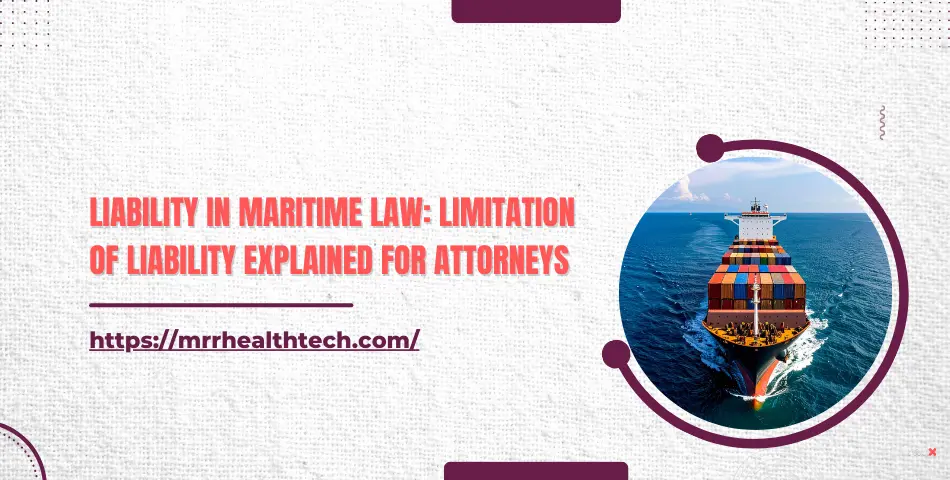
Liability in maritime law plays a critical role in determining how responsibility and compensation are assigned after maritime accidents, vessel collisions, offshore injuries, and shipping incidents. One of the most complex doctrines within maritime law is the Limitation of Liability, which allows shipowners to limit their financial responsibility under specific legal conditions.
For attorneys handling maritime personal injury, wrongful death, or commercial shipping claims, understanding how limitation of liability works and how medical evidence impacts recovery can directly affect case strategy, settlement leverage, and trial outcomes. This guide explains the legal framework, real-world implications, and the importance of medical records review in strengthening maritime claims.
What Is Limitation of Liability in Maritime Law?
Limitation of liability in maritime law allows a vessel owner to limit financial liability to the value of the vessel and its freight after an incident provided the owner lacked “privity or knowledge” of the negligence. This doctrine aims to balance commercial shipping risks with fair compensation for injured parties.
Legal Background and Evolution
Originating from maritime commerce traditions and codified in modern maritime statutes, limitation of liability has evolved to address:
- Vessel collisions
- Offshore worker injuries
- Cargo loss
- Passenger injury claims
- Environmental maritime incidents
Courts closely examine whether shipowners exercised reasonable care and safety oversight.
Key Legal Elements That Determine Liability in Maritime Law
Who Is Eligible to Claim Limitation of Liability in Maritime Law?
Not every shipowner qualifies. Courts evaluate:
- Ownership status
- Operational control
- Safety compliance
- Maintenance standards
- Crew training procedures
If negligence occurred with the owner’s knowledge, limitation of liability may be denied.
Filing Process and Legal Requirements
To invoke limitation of liability, vessel owners must:
- File a petition in federal court
- Deposit the vessel’s post-incident value
- Provide accident documentation
- Disclose safety and operational records
- Submit timelines of the maritime incident
This process creates strict deadlines that attorneys must manage carefully.
How Limitation of Liability Impacts Compensation?
Limitation proceedings may:
- Reduce claimant recovery
- Restrict settlement amounts
- Delay claim resolution
- Create multi-party litigation
- Shift leverage toward defendants
Attorneys must counter this by presenting strong evidence of owner negligence.
Common Myths About Liability in Maritime Law
Myth 1: Limitation of Liability Protects All Shipowners
Ship-owners remain subject to limitations based on circumstances of the particular accident and the registration status of the vessel.
Myth 2: Limitation of Liability Eliminates Responsibility
Limitation does not mean absconding responsibility; ship-owners are still liable but to a limited extent.
Why Medical Records Are Critical in Maritime Liability Cases?
Importance of Medical Documentation
Medical records establish:
- Injury severity
- Causation linkage
- Timeline consistency
- Long-term disability impact
- Economic damages
Incomplete records weaken maritime injury claims and can reduce settlement value.
How Medical Records Review Supports Attorneys?
Professional medical record review helps attorneys for liability in maritime law:
- Identify missing treatment gaps
- Correlate injuries with incident timelines
- Validate expert opinions
- Support causation arguments
- Strengthen damages calculation
This becomes vital when defendants attempt to limit liability.
Case Studies
1: The Fishing Vessel Accident
- Overview of the Case: Multiple crew members suffered injuries in a commercial fishing vessel accident where the vessel capsized.
- Challenges: The ship-owner sought a maritime limitation of liability arguing that the vessel’s valuation post-incident was significantly less than the damages incurred.
- Solutions: With the aid of medical records review services, attorneys were able to reconstruct the injuries and document the long-term impact on the victims’ lives.
- Compensation: The court awarded compensations that were in excess of what the vessel was valued at post-settlement based on the medical evidence provided.
2: Recreational Boating Collision
- Overview of the Case: Jet Ski operator sustained catastrophic injuries when a recreational boat collided into the Jet Ski.
- Challenges: The ship owner tried to minimize their liability as a fragment of the blame lay with the Jet Ski operator.
- Solutions: The legal team showcased the medical records to highlight the severity of injuries sustained and the treatment required.
- Compensation: A comprehensive amount was awarded to settle the dispute owing to contested liability, with the extensive medical documentation presented.
Strategic Considerations for Attorneys Handling Maritime Liability Claims
Attorneys should following for strategic Liability in Maritime Law:
- Secure vessel maintenance records early
- Correlate injuries with incident timelines
- Anticipate limitation petitions
- Prepare medical chronologies
- Use expert medical opinions to establish negligence impact
Conclusion
Liability in maritime law especially limitation of liability significantly impacts how compensation is calculated in maritime injury and shipping cases. Attorneys who combine strong legal strategy with well-organized medical evidence are far better positioned to defeat liability limitation attempts and maximize client recovery.
If you handle maritime injury or vessel accident claims, having clean medical chronologies and organized clinical evidence can make or break liability in maritime law. Professional medical records review helps uncover gaps, timelines, and causation that courts rely on in limitation of liability disputes.