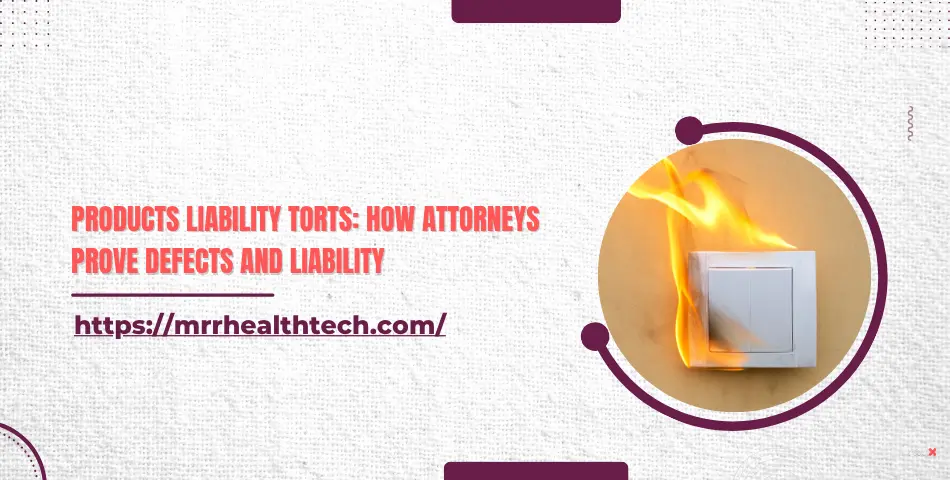
When a consumer suffers injuries due to a faulty product, the road to redress usually proceeds through the prism of Products Liability Torts. Defective products cause damage and hold the manufacturer, distributor, or retailer responsible for them. It is up to the lawyer to skilfully dwell in product liability tort law in order to prove the existence of a defect and for the client to be properly compensated.
In this handbook, we will analyze how Products Liability Torts are constructed, the part of negligence and or strict liability, and the fundamentals soft the attorneys that must be primary in crafting the documents.
Understanding Products Liability Torts
In its most simplified and straight forward formulation, Products Liability Torts are legal actions taken against a business for injuries or damages caused by their faulty products. These torts are further subdivided into a few different types.
Negligent Product Liability – asserted against a manufacturer or seller who failed to take due care.
Product Liability Claims in Strict Liability – indiscriminately negligence-proof claims of liability against a business.
Manufacturer’s Liability in Tort – obligations of a producer for a defective design, flawed manufacture, or inadequate warning.
Lawyers are required to deal with product negligence claims and strict liability products claims in formulating refined legal tactics.
Negligence and Strict Liability in product Liability Torts
Negligence in Product Liability
In cases of negligence product liability, the attorney needs to show that the manufacturer or the seller did not behave in a reasonable manner. This can include inattention to any or all of the negligence’s reasonable pokers—inattention to safety, providing no warning at all, or lacking in controlling the quality of products.
Product Negligence examples include:
• A toy with small detachable parts sold without a choking hazard warning.
• Medical devices released without sufficient safety testing.
Strict Liability in Product Liability
In strict liability and product negligence cases, unlike negligence cases, there is no burden of proof for carelessness. It is sufficient to show the product is defective and the injury is a consequence of the product to blame the company.
In their work, attorneys don’t miss adding to their arguments the famous strict liability cases and the Restatement of Torts Products Liability, and then the restatement third of torts product liability and the restatement third of torts product liability.
Defects in product liability tort cases and their types
Design Defects
Attorneys hold a combination of product liability and negligence for a product that has a dangerous flaw in its design.
Manufacturing Defects
In product liability tort cases, in the event the design is safe but the product has been manufactured incorrectly, the focus tends to be on the manufacturer liability in tort.
Marketing Shortcomings (Failure to Warn)
An example of a product being removed from the market is the omission of necessary safety procedures, where a business neglects to inform the customers of the risk, which is known and reasonable.
A Legal Approach to Product Liability Torts
The Restatement of Torts Products Liability sets out foundational rules for the jurisdiction of the claims. Lawyers often use the Restatement Third of Torts Products Liability when preparing their position in litigation.
In reality, product liability and mass tort claims arise in situations when a faulty product harms a large number of consumers, especially in the case of defective drug or medical device claims. These large lawsuits illustrate product liability torts in their most naked form and how these liabilities torts aim to protect such mass destruction.
The Ways Lawyers Establish Liability in Products Liability Tort Claims
Building a case which proves the burden of proof requires fulfilment of three important components.
- Defect Existence – Identification of a marketing, manufacturing or design defect.
- Causation – Proving the defect is the reason the injury occurred.
- Liability – Ascribing the negligence and strict liability principles to the manufacturer or distributor.
To illustrate how product liability torts work, it is not uncommon for lawyers to quote how courts decided in subsequent similar cases.
Expert Medical Consulting Works Help Medical Evidence Works Help Documentation Assisting
In many Products Liability Torts, medical evidence becomes essential in proving harm. Attorneys depend on Expert Medical Opinion Services for connection and for defects in products and client partition injuries. Expert Medical Opinion Services account for testimonies on the effects of the product on the client’s body over long durations. Medical records and documents are sufficiently elaborated, and the expert witnesses are able to clarify them to the judges and the jury understands.
In these cases, it our joint effort that will associate defects in the products, and the resulting damage to these products. Employing these means instruments increases the chances of winning.
Conclusion for Lawyers
This would include Products Liability Torts, which is essential for maintaining the Well-being and safety of the consumers, while the corporations take the corresponding responsibility for their action. Attorneys are able to help their clients emerge victorious in these tough cases due to their understanding of the difference in product liability negligence, and the tools in the Restatement Third of Torts Products Liability.
FAQs about the Products Liability Torts
What types of defects are covered under products liability torts?
A tort can include design, planning, and machinery mistakes, as well as poor play advertisements, inadequate criticism, and inadequate direction.
Who can be held liable in a products liability case?
In such case, one can include those in the business of making, selling, distributing, and in some cases, supplying the product. These rest as any individual involved in the chain of that particular product.
How do attorneys prove liability in a product liability tort case?
To prove a defect, causation, and liability, attorneys need to meet certain criteria such as legal frameworks of strict liability products or product negligence.
If your law firm needs assistance in case research or supportive medical documents and expert testimony, we are happy to assist. Our team can provide you with medical and legal advice to enhance your litigation strategy.