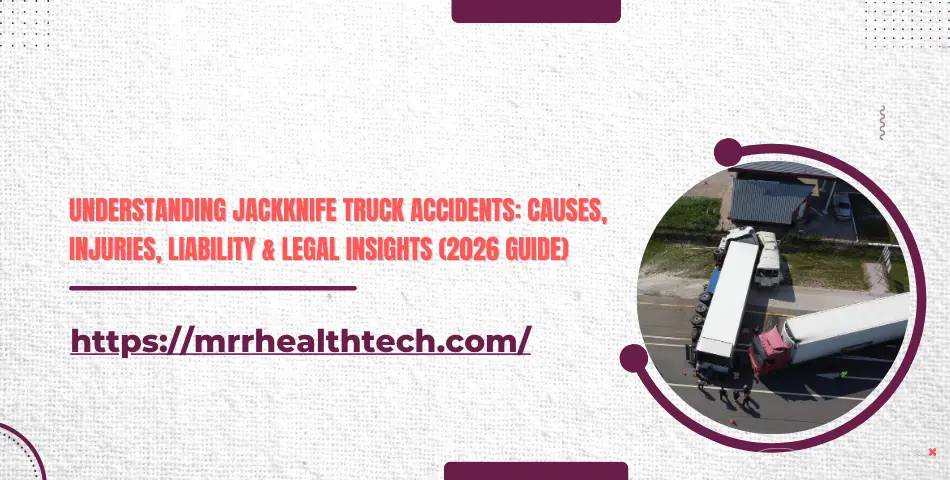
Jackknife truck accidents are one of the primary problems in the transportation sector, as it is a source of very grave injuries san deaths. For attorneys, especially those who represent injury victims or challenge liability claims, understanding the causes and implications of these accidents is highly important. This article gives a detailed explanation of jackknife truck accidents, how medical record reviews contribute to legal cases, and valuable tips for attorneys.
What is a Jackknife Truck Accidents?
Jackknife Truck Accidents: In this category, truck accidents trailer slides and extends perpendicularly to the cab, creating an angle just like a jackknife does when folded. It may also result in the loss of control of the vehicle and subsequent collisions with other automobiles or structures.
Statistics and Legal Implications
- Statistics: The National Highway Traffic Safety Administration (NHTSA) reports suggest that every year truck accidents result in the death of about 5,788 people in 2021 in the United States. Jackknife incidents are one of these.
- Legal Implications: It is important for attorneys in control of related contingencies to have accurate knowledge of the dynamics and reasons behind jackknife accidents.
Common Causes of Jackknife Truck Accidents
Driver Error
- Inexperience: New drivers or people who are not used to driving large vehicles might find it difficult, if not impossible, to drive under bad weather conditions.
- Distracted Driving: The utilization of mobile devices or any other distractions can lead to lapse in judgement.
Weather Conditions
- Rain and Snow: Wet and snow-covered roads can result in loss of grip which can lead to jackknifing.
- High Winds: Powerful winds can steer an empty trailer off its intended path.
Mechanical Failures
- Brake Malfunctions: If brakes do not work properly a driver may be unable to stop the vehicle thus greatly increasing the chance of jackknifing.
- Tire Blowouts: A blowout may occur and create a loss of control of the vehicle.
Improper Loading
- Weight Distribution: Jackknifing can happen when the total weight of the cargo is imbalanced, affecting how the truck is balanced.
- Overloading: Weight restrictions are in place to ensure the vehicle can be controlled and able to stop.
Road Conditions
- Poorly Maintained Roads: Potholes, debris, etc. can greatly increase the chance of an accident occurring.
- Sharp Turns: Higher speeds on tight curves, one may expect a jackknifed truck.
Recent Trends and Data (2025-2026)
Technological Advancements for prevents Jackknife Truck Accidents
- ESC (Electronic Stability Control): Directly prevents unstable trailer swing
- ADAS (AEB, LDW, Blind Spot): Reduces human-error triggers
- Sensor-Based Control Systems: Early detection & correction
- AI & Trailer Angle Monitoring: Predictive jackknife prevention
- Enhanced Brake/Torque Control: Balanced deceleration
- Mechanical Anti-Jackknife Devices: Limits articulation physically
Regulatory Changes
- Increased Inspections: Regulatory bodies are conducting more frequent inspections to ensure compliance with safety standards.
- Updated Training Requirements: New regulations emphasize the importance of comprehensive training for truck drivers.
The Role of Medical Records Review in Jackknife Truck Accidents
What is Medical Records Review?
- Definition: A systematic review of medical records to identify relevant information related to injuries sustained in jackknife accidents.
- Purpose: To support legal cases by providing accurate timelines of medical treatment and outcomes.
How Medical Records Review Supports Jackknife Truck Accidents?
- Establishing Causation: Medical records can help establish a direct link between the accident and the injuries sustained.
- Documenting Treatment: Comprehensive records provide evidence of the medical care received, which is crucial for compensation claims.
Case Studies
Case Study 1: Logistics Nightmare
What happened: A semi-truck experienced a jackknife incident on Surrey’s Highway 1 on the morning rush hour in May of 2025. The trailer created a 70-foot-tall steel-enforced barricade completely sever the main access point into Vancouver.
What it caused: Fortunately there were no fatalities; however, the traffic in the area was backed up for over three-and-a-half hours.
What was the impact: Since on the incident traffic had to be redirected into a single-lane truck pull-off area, thousands of commuters experienced delays and the one incident of a jackknife created millions of dollars of lost productivity and logistic gridlock.
Summary: Jackknife incidents aren’t only dangerous but very detrimental to the city’s transportation network or “circulatory system”.
Case Study 2: Tragedy of Negligence
What happened: A truck experienced a jackknife incident in November of 2025 along a dark, lonely stretch of U.S. Highway 20 in Oregon. Both lanes of traffic were completely blocked. A newlywed couple married just 16 days prior hit the trailer and were killed instantly.
What was the conduct: Following an investigation officials discovered the driver had failed to use emergency warning devices (flares/triangles). As a result of the darkness the trailer became an invisible barrier.
What was the legal outcome: The driver was charged with 1st Degree Manslaughter and issued an ICE detainer. This case sparked a national discussion regarding the standards for commercial driver’s licenses for those who are undocumented.
Takeaway: Safety protocols like flares aren’t just “suggestion”, they are the difference between a mechanical mishap and a criminal tragedy.
Conclusion
Accidents involving jack-knife trucks rank among the most dangerous on the roads and can be attributed to recklessness or blatant malfunction of the vehicle. However, legal experts on behalf of the clients harmed in the accidents should consider all these aspects and apply the technique known as medical record review. By keeping abreast of new developments in their field and broad range information, legal practitioners would be in a position to defend their clients and obtain justice on behalf of the clients’ suffered losses.
FAQS about Jackknife Truck Accidents
What percentage of truck-related crashes involve jackknife?
Jackknife incidences may be small in number in relation to other accidents involving large trucks; however, the number of fatal accidents and injury/property damage accidents caused by jackknife incidents is considerably higher than the percentage of these types of accidents.
What type of truck is prone to jackknifing?
Typically, jackknifed large trucks originate from tractor-trailers with articulated joints that allow the trailer to move independently of the truck, the tractor portion. Consequently, long-haul semi-trucks and tankers as well as fully loaded nose trailers are more susceptible to jackknife accidents during poor road conditions or when braking is inconsistent. Therefore, if a single-unit truck is involved in a jackknife accident, the accident will either be caused by a mechanical malfunction or improper loading procedures.
Is jackknifing always the driver’s fault?
Not every jackknife accident is necessarily the fault of an operator. While it is true that many factors can lead to jackknife situations, the types of factors that are more likely to occur include external factors such as poor road surfaces, mechanical failure, brake imbalance, poor loading, and most importantly, the complete absence of modern stability control systems on most large trucks. Additionally, liability for a jackknife accident typically rests on the trucking company’s ability to have maintained their equipment properly and whether or not proper safety technology was installed and being maintained on the vehicle at the time of the accident.
Need support reviewing medical records for a truck accident case?
Contact us today for expert assistance and get precise Medical Records Review from our experts to build stronger jackknife accident claims!